 Book now
 Is Dalí's house in Portlligat worth it, and who should skip it
An honest look at what you see, how it feels in a small group, and who will be happier somewhere else.
For most people with an interest in Dalí, yes. Portlligat is the house where he and Gala lived and worked for decades, kept with its original interiors: the private rooms, the studio with its easels, the Olive Grove and courtyards, and the bay framed in every window. The visit takes about an hour, in a small group of up to eight with staff. It is not for everyone. It is not accessible for wheelchair users, the stairs are narrow and uneven, you must be at the ticket office 30 minutes early, and if you want a large collection of paintings, that is Figueres.
What you actually see
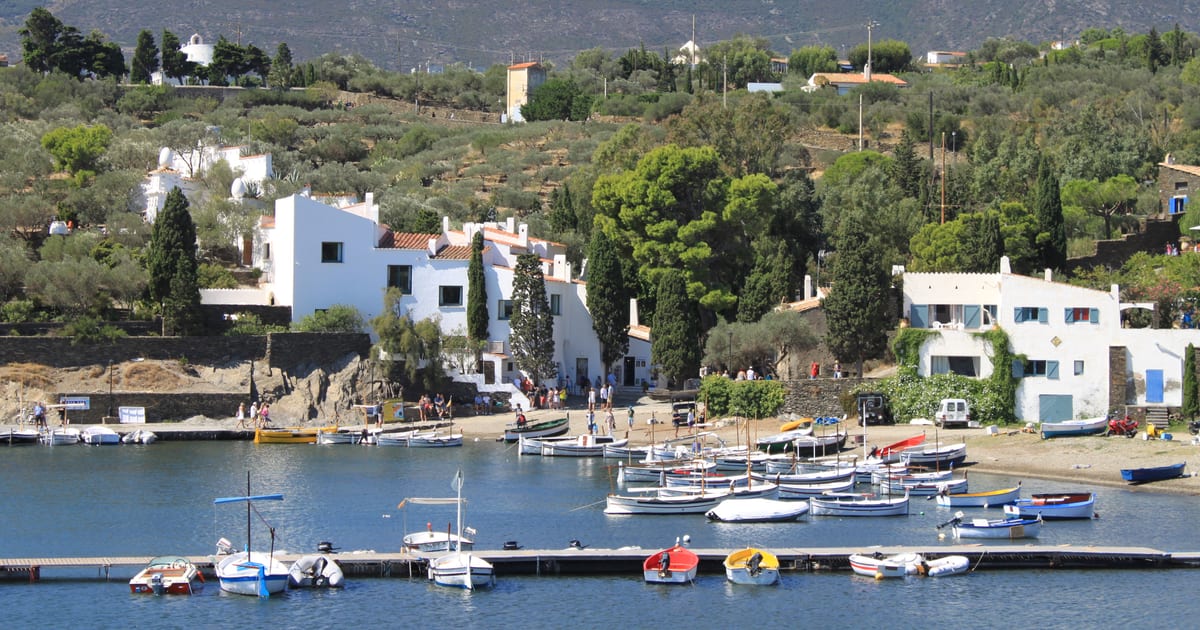
Portlligat is a home, not a gallery, and that is the first thing to understand. The house grew from a row of fishermen's huts into a cluster of small whitewashed rooms on the shore, and the museum keeps the original interiors as the couple lived in them. You are walking through the rooms where they slept, read, received friends and worked, not past a sequence of framed pictures.
The Foundation divides the visit into three areas. The private rooms, numbered 1 to 5 and 8 to 13, are where the Dalís made their private life, from the entrance hall with its stuffed polar bear to the bedroom where a mirror let him see the sea from bed. The studio, rooms 6 and 7, holds many objects from his working life, including easels and brushes. The Olive Grove and courtyards, rooms 14 to 20, were for public life and passing creative work.
What ties it together is the view. Every room has windows, each a different shape, and every one looks out on Portlligat bay, a subject he returned to again and again. Outside, there is the swimming pool area, with its lip-shaped sofa and swan fountains, and white eggs along the roofline. It is odd, personal and very particular, and that is the reason to go.
How long it takes and how the visit runs
Allow about an hour in all. The Foundation's FAQ describes roughly thirty minutes through the interior with your group, followed by the outdoor part at your own pace. Groups set off every ten minutes from opening time, so the day runs to a steady rhythm. The museum and ticket office take their last entries 40 minutes before closing, and the rooms close 15 minutes before.
It is not a traditional guided tour. Museum staff accompany each group through the house, which keeps the flow moving through rooms that are too small for anyone to wander freely. Do not count on an audio guide, as none is mentioned on the Foundation's pages. Reading a little before you go, even a short history of the house, makes the rooms far easier to understand. If you hold a reduced ticket, bring proof of eligibility, such as a student card or proof of age for over-65s. The Foundation says the same discounts apply to non-EU visitors.
Plan the hour on either side as well. You must collect your tickets at the ticket office on Platja de Portlligat 30 minutes before your slot, and parking near the cove is limited. If you come by coach, the Cadaqués bus station is about 2 km from the house. Nobody regrets arriving early here. There is a bay to look at while you wait.
What it feels like in a group of eight
The small group is the defining feature of a Portlligat visit, and it is mostly a good thing. With up to eight people and a member of staff, you see each room without a crowd pressing in. You can stand at a window and actually look. In a house built from narrow corridors and small changes of level, a larger group simply would not fit.
The trade-off is pace. Inside, you move with your group, so you cannot linger in one room for twenty minutes while the others go on. Some rooms can only be reached through others, and the stairs are narrow, so the route has a natural order. If you like to take your time, save your lingering for the Olive Grove and courtyards, where you are free to set your own speed. Indoors, follow the staff's lead on where to stand and keep your hands off the objects. This was a lived-in home, not a display built for visitors, and it is kept that way.
It also means the visit feels personal in a way large museums rarely do. You are a handful of people in someone's home, close enough to see the books, the objects on the shelves and the light on the walls. That intimacy is the main reason to come. For anyone who dislikes being in a small group with strangers, it may feel close, but it is short.
Who will love it
You will probably love Portlligat if you are curious about how artists live and work. The studio is the heart of it, and seeing his tools in the room where he used them says more than many biographies. The same goes for anyone interested in houses and interiors. It is a rare example of a home that grew for forty years around one couple's habits and one view.
It is a natural second visit for anyone who has already been to the Theatre-Museum in Figueres. Figueres is the public statement. Portlligat is the private side, quieter and more domestic. Seen together, each makes the other easier to understand, and Gala's castle at Púbol completes the picture if you have time for a third day.
It also suits travellers who are happy to plan. Because every visit is booked for a set time, you can build a calm day around it: a morning in the house, lunch in Cadaqués, an afternoon on the cape. Couples, small groups of friends and photographers who enjoy working with natural light through small windows all tend to get a lot from it. And if you have read about Gala's Oval Room, the rounded space with echoing acoustics where she read and received visitors, seeing it in place is a quiet reward.
Who should skip it, or think twice
Wheelchair users and people with limited mobility should think carefully. The Foundation says plainly that the house is not wheelchair accessible. The staircases are narrow and irregular, and the levels change constantly, which makes it hard going for anyone with reduced mobility. Gala's castle at Púbol is a much better choice, since most of it is accessible.
Skip it, too, if you cannot be sure of being at the ticket office 30 minutes before your slot. This is the rule to take most seriously. If you do not collect your tickets in time, the booking is cancelled and the tickets are lost, with no refund, and later entry depends on space. If your day is built around a long drive or an unreliable connection, choose a later slot or a different day.
And if you are hoping for a big collection of paintings, go to Figueres instead. Portlligat is a house, with a studio, not a picture gallery. Spontaneous travellers should also know there are no same-day tickets online, so it is not a place to decide on over breakfast. Finally, medium and large bags, backpacks worn on the back and pushchairs are not allowed inside, though there is left-luggage opposite the entrance.
Visiting with children
Children are welcome, with a few conditions. Anyone under 16 must be with an adult. Children aged 0 to 8 enter free, and with us they are added to your booking at no charge. They still need their own ticket, though, and each one takes a place in the group of eight, so count them when you choose your tickets. Ages 9 to 17 have their own ticket type.
Think about the stairs and the space before bringing very young children. Pushchairs are not allowed inside, and the stairs are narrow and uneven, so small children will need carrying or a firm hand in places. The rooms are full of objects, and the visit moves at the group's pace. Eating and drinking are not allowed inside, so give everyone a snack before you go in.
For older children there is plenty to catch the eye. A stuffed polar bear at the door, eggs on the roof, a pool with a sofa shaped like lips and a house that feels like a maze make it more fun than a formal gallery. Keep the hour short and lively, then let them loose on the beach at Portlligat or in the coves around Cadaqués.
Photography and house rules
You can take photos without flash, for personal use. Flash, tripods, selfie sticks and professional equipment are not allowed. If you want to publish images taken inside the house, the Foundation requires a licence and payment of rights, so treat your photos as personal mementos. The rooms are small and your group shares them, so take your shot and then step aside for the next person. In practice, the small rooms and natural light from the windows reward a steady hand and a little patience.
The other rules are simple. No food, drink or smoking inside. No pets, except guide dogs. There is no café or restaurant at the museum, though the toilets are adapted. Bulky items are not allowed in the rooms, and the Foundation's FAQ gives a size limit for what you can carry. A small bag or a jacket with pockets is the easiest way to go.
One more practical point. Every visitor needs a ticket, including children who enter free and anyone in other free categories. With us, you choose a date, a slot and the tickets for your group, and see the total in your currency before paying. We book the visit on your behalf and email you the booking in your name, ready to show when you collect your tickets.
Best season, time of day and what to do nearby
The house opens every day from April to October, with longer hours from mid-June to mid-September, and Tuesday to Sunday through the cooler months. It closes from early January to mid-February. Spring and autumn are the most comfortable times for the walk down to the cove and the outdoor rooms. Slots go days ahead even in autumn, and further ahead in summer, so book once your dates are fixed. In the cooler months the house is closed on Mondays, apart from a few exceptional openings, so check the day of the week before you plan a winter trip.
For time of day, a morning slot leaves the rest of the day free for Cadaqués and the cape, and avoids rushing back along the winding road. A later slot suits you if you are driving in from Figueres or Girona. Whichever you choose, give yourself the 30 minutes at the ticket office and a few spare minutes for parking.
Around the house, Cadaqués is the obvious next stop: the waterfront, the church of Santa Maria, cafés, galleries and small coves for a swim in warm weather. Beyond Portlligat, the road runs out to Cap de Creus, the easternmost point of mainland Spain, a dry, rocky natural park with deep blue inlets and a strong northerly wind. Bring a layer. It is the landscape that drew Dalí here in the first place.
Frequently asked
How long does a visit to Dalí's house take?
About an hour. Around thirty minutes are spent inside with your group and a member of staff, then you see the Olive Grove and courtyards at your own pace. Add the 30 minutes you need at the ticket office beforehand.
Is Dalí's house in Portlligat wheelchair accessible?
No. The Foundation states that the house is not wheelchair accessible, and its narrow, irregular staircases make it difficult for anyone with reduced mobility. The Gala Dalí Castle at Púbol is mostly accessible and is a better choice.
Can I take photos inside?
Yes, without flash and for personal use. Flash, tripods, selfie sticks and professional equipment are not allowed, and publishing photos taken inside requires a licence and rights payment from the Foundation.
Can I bring children?
Yes. Under-16s must be with an adult. Children aged 0 to 8 are free, added to your booking at no charge, but each still needs a ticket and takes a place in the group of eight. Pushchairs are not allowed inside.
Is it worth it if I have already seen Figueres?
Yes, because it is a different kind of visit. Figueres holds the large collection. Portlligat is the private home and studio, small and personal, and the two make sense of each other.
What happens if I arrive late?
You must collect your tickets at the ticket office 30 minutes before your slot. If you do not, the booking is cancelled and the tickets are lost with no refund. Later entry is possible only if there is space.